
+49 8063 2569772
info@neomium.eu

An important milestone for Paratrone: With the successful completion of the project and a final demonstration flight, we impressively showcased the potential of our paraglider-based cargo drone. In the future, it is intended to transport heavy payloads with virtually no emissions to locations that have previously been difficult to access.
With the successful final presentation of our funded “Paratrone” development project, we reached a significant milestone. The project received funding under the third 2023 HAMI funding call of the Holistic Air Mobility Initiative. Its aim was to establish the technological foundation for an innovative paraglider-based cargo drone and demonstrate its potential for sustainable transport applications.
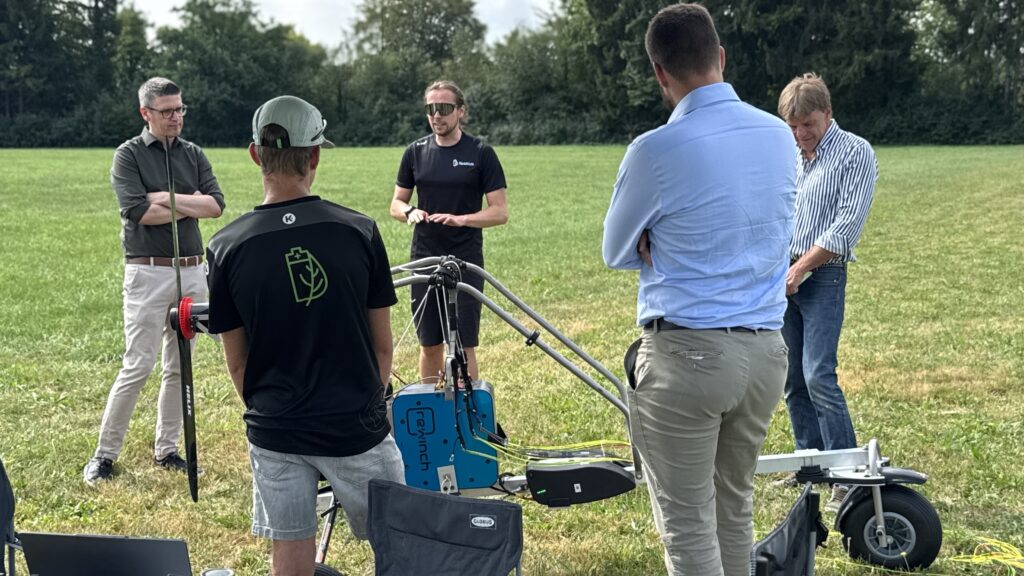
At the closing event, we were pleased to welcome Mr. Steinhäuser from IABG and Mr. Bedenk from the Bavarian State Ministry of Economic Affairs, Regional Development and Energy. Together, we reviewed the progress made throughout the project, the insights gained, and the next development steps.
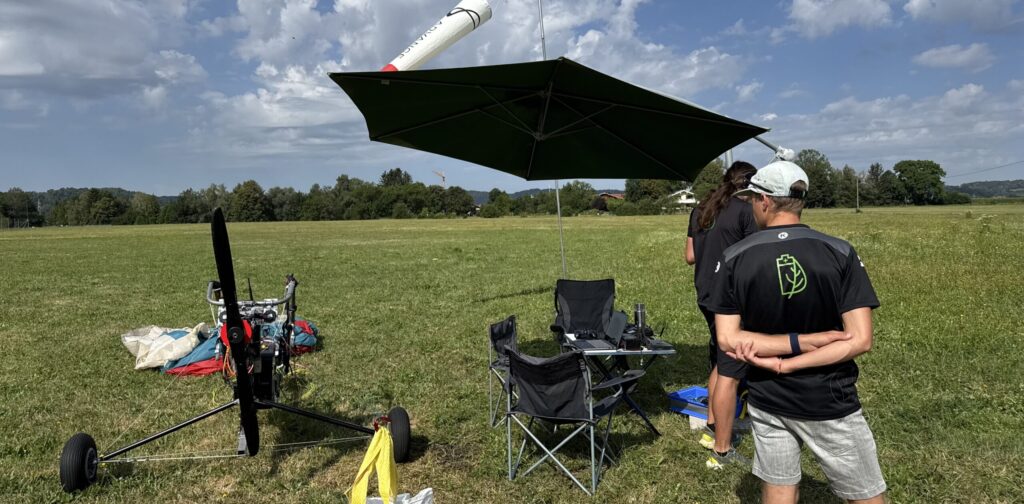
In addition to the detailed presentation of the project results, our guests gained insights into our development work during a tour of the company. The highlight of the event was a final demonstration flight of Paratrone, during which we were able to showcase the system’s current state of development under real-world conditions.
For us, this event was far more than a formal conclusion to the project. It provided an opportunity to bring together the results of the recent development phase, discuss them openly, and demonstrate Paratrone’s potential.
Paratrone is a paraglider-based cargo drone designed to transport payloads of up to 500 kilograms cost-effectively and with virtually no emissions in the future. The concept is aimed particularly at locations that are difficult, costly, or impossible to reach by land.
One potential application is supplying mountain huts and other remote locations. In mountainous regions or areas with limited infrastructure, conventional transport often involves considerable logistical effort. In the long term, Paratrone is intended to provide a flexible and resource-efficient alternative.
The concept also opens up further possibilities. These include the targeted distribution of seeds or fertilizers, as well as potential applications in support of firefighting operations. With its high planned payload capacity and distinctive flight platform, Paratrone could eventually be used wherever materials need to be transported reliably across difficult terrain.
A key part of the project’s conclusion was the demonstration flight. It not only showcased the progress made so far but also provided valuable insights for further development.
Practical testing is essential, especially for innovative aviation systems. Only through the interaction of the individual components does it become clear which approaches already work reliably and where further optimization is required. Every test flight therefore helps us better understand the overall system and develop it further step by step.
For our team, the demonstration was an important validation of the work completed so far and, at the same time, a valuable starting point for the upcoming development phases.
Technological innovation does not arise from a good idea alone. It requires people who pursue it with perseverance, partners who believe in its potential, and conditions that enable demanding development work.
We would therefore like to express our special thanks to the Bavarian State Ministry of Economic Affairs, Regional Development and Energy and to IABG for their funding, trust, and constructive support throughout the project. The regular exchange and expert guidance made an important contribution to the project’s successful progress.
We would also like to thank our entire team. Without your dedication, perseverance, and ingenuity, this milestone would not have been possible. From concept development and technical implementation to practical testing, the project was a true team effort.
The final presentation marks the end of an important funded development phase—but Paratrone’s journey continues. The insights gained provide the foundation for the next technical steps and further testing of the system.
Our goal remains clear: We aim to further develop Paratrone into a powerful and sustainable solution for transport operations in hard-to-reach regions. In doing so, we want to contribute to an air logistics system that can be deployed flexibly, economically, and with virtually no emissions.
We look forward to taking the next steps together with our team and partners and bringing the vision behind Paratrone closer to reality.